Licensing

How pricing is decided

Pricing is not driven by how many people use the product, but by how many production database servers it protects. Every module, every database engine and unlimited users are included. This page explains how the calculation is built.

The calculation

Two items, nothing else

There are no hidden items. A quote is made of two headings, and you receive it itemised.

Platform fee + production database server fee

1. Platform fee

It is fixed and identical in every quote. It contains all six modules, all three database engines and unlimited users. You do not pick modules, you do not pick engines, you do not count users.

2. Production server fee

Calculated from your production database servers only. There is a price for the first server, and every additional server is cheaper than the one before it by a fixed rate.

Test and development servers are free. They are neither counted nor capped. Catching a change before it reaches production starts in non-production environments; a licence that made this expensive would work against the product itself. You can bring all of your non-production environments into scope.

Server fee

Every extra server costs less than the one before

Three rules decide the server fee. All three are given to you in writing before the quote.

Starting point

The first production server has a fixed price. The calculation starts there.

Step down

Every new server is cheaper than the previous one by a fixed rate. The more you bring into scope, the less you pay per server.

Floor

The unit price never drops below a floor. That floor is known from the start and does not change later.

Why step down? A flat per server price punishes widening the scope and pushes an organisation to leave some servers out. Every server left out of scope is also left out of governance. So the cost of adding one more server falls each time, and there is no jump at any point.

Unlimited beyond a threshold. Once your production server count reaches a defined threshold the price is frozen there and your licence is issued as unlimited. Beyond that point you can add as many servers as you like at no extra cost, and you stop counting servers altogether.

Quote

We ask one question for a quote

How many production database servers will come into scope. Once we have the answer the calculation follows on its own, with no long discovery process.

We do not ask: how many people

The number of users is unlimited. There is no per seat charge for the developer who raises a request, the manager who approves it, the administrator who runs it or the auditor who reads the report. Governance only works if everyone is in the system, and the licence should not stand in the way.

We do not ask: which modules

All six modules are enabled in every licence. If you need a module tomorrow that you do not use today, no extra invoice appears and you do not go back through procurement.

We do not ask: which engines

SQL Server, PostgreSQL and Oracle are all included. If you move to another engine tomorrow, or need to add a second one, the price does not change.

What we mean by a server. A unique, active database connection target defined in the product. The number of databases, schemas and objects inside a server does not affect the price. In clustered setups the single connection address defined in the product counts as one server. A server set to inactive is neither counted nor usable, and its quota is released.

Core

What every licence includes

The following are not modules and are never sold separately. Whatever you buy, these are enabled.

Change
  • Change requests, approval flow and controlled execution
  • SQL parsing and the rule catalogue
  • Risk band and policy based approval
  • Critical object protection
  • Raising a request with a hand written rollback script
Evidence
  • Signed audit trail
  • Sealed copy in a separate database
  • Database level write log
  • Per request evidence file
  • Export of request and audit records
Administration
  • Unlimited users
  • Role and permission management
  • Sign in through your directory server
  • Bulk user import from a file
  • Four eyes approval on settings changes
Modules

All six modules are included

Each one answers a separate need and all of them sit inside the platform fee. You do not select modules and you do not pay for them separately.

Query governance

Requests to pull data from a production database are put on record. Sensitive columns are detected, masked, tied to a justified second approval, and the result is delivered encrypted.

Rollback and recovery

Automatic generation of the rollback script, and the rule that a change cannot reach approval without one. Raising a request with a hand written rollback script is part of the core.

Reporting and insight

Ready made management reports and object change history. The audit trail itself and the per request evidence file are part of the core; this module adds the management view.

Release packages

Grouping several dependent changes into a single package and running them all or nothing. Built for release nights.

Sandbox trial

Trying the script on a separate server before it reaches production. A script that does not run is eliminated without occupying the approval process.

Scheduled execution

Scheduling an approved change into a maintenance window and running it automatically at that time. Cancelling a schedule is possible in every licence.

Why we do not sell them separately. Sold separately, each module becomes its own negotiation item and the price conversation crowds out the product conversation. Worse, a team that lacks a module at the moment it is needed settles for what it can do instead of doing the right thing. Including everything removes both problems.

Scope

What the price includes and how the licence works

Included in the price

First year installation and user training, version updates and support. Installation is not billed as a separate consultancy item. The product is designed to be stood up in a clean environment quickly.

The product is installed in your own environment. Your databases, your scripts and your audit records never leave your organisation.

How the licence works

The licence is a file produced for your organisation. It carries the validity date, the enabled modules, the enabled database engines and the production server limit. Reaching the limit does not stop the system; it only prevents adding a new production server. When it expires a defined grace period applies; the system does not shut down abruptly.

The licence is not locked to hardware. Changing servers, moving environments or running a disaster recovery exercise does not force you to request a new file.

Loading the wrong file does not cost you your working licence: an invalid file is rejected and the system keeps running on the previous one. Loading and reloading a licence are both written to the audit trail.
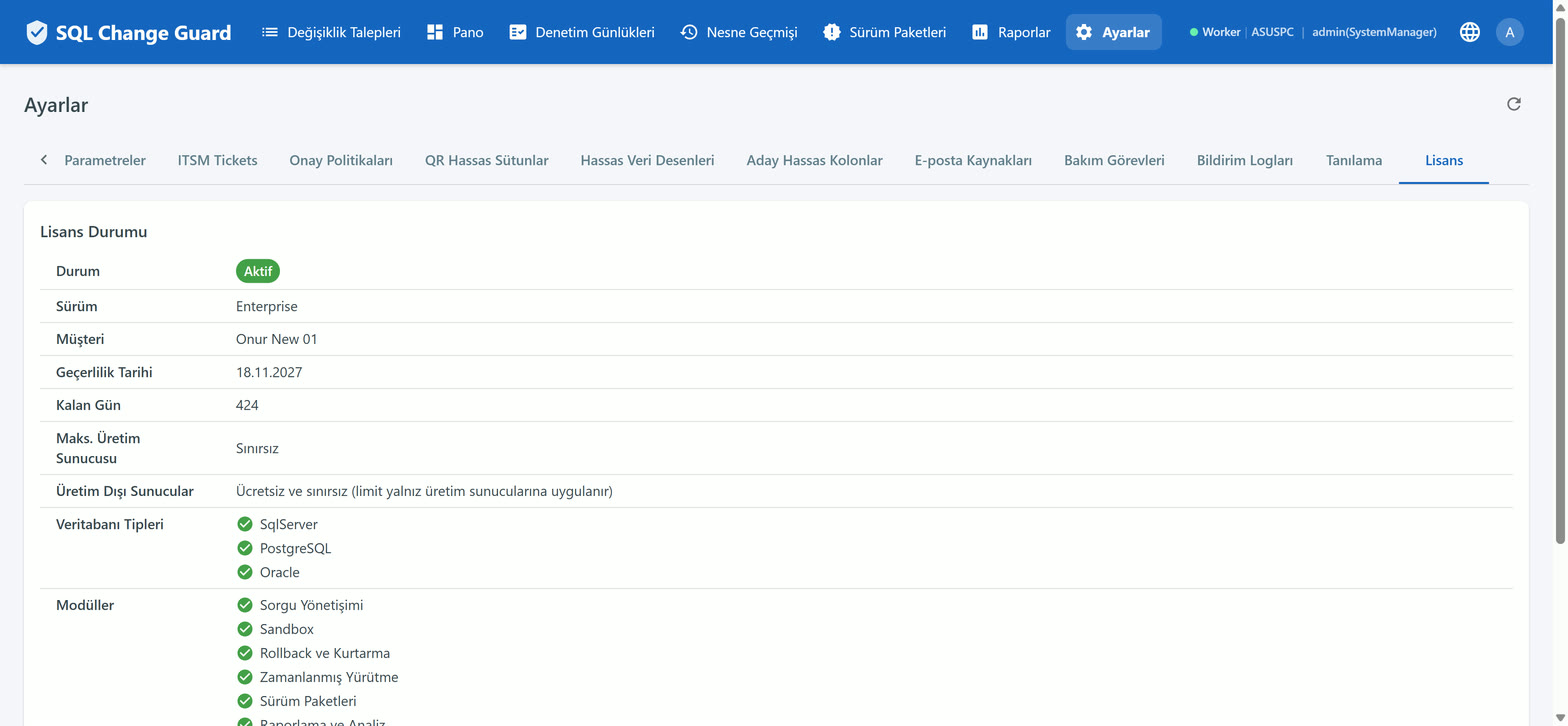
Licence screen showing the active edition, its validity date, the enabled database types and the licensed modules
Licence screen Your scope is visible inside the product: which modules are on, which engines are on, what the limit is.
Common questions

About licensing

Does the price rise as our team grows?

No. The number of users is unlimited and appears nowhere in the pricing.

What if we add servers during the year?

We do not charge you. We issue a new licence file and the difference is reflected only at renewal. Growing during the year costs nothing, and you do not have to wait for a new procurement cycle to widen the scope.

What if we move to another database engine?

The price does not change. All three engines are supported by the same product under the same licence; you do not buy a separate product or run a separate installation.

How many years do we have to commit to?

None. A single year subscription is enough. A multi year commitment is optional and earns a discount. If your server count has not changed, the renewal price does not change either, and that is stated in the first quote.

Can we try it first?

Yes. A time limited trial licence enables every module and every database engine, so you can evaluate the whole product.

Scale

What kind of line item this is

We do not print a number on this page, because a number given without scope misleads both sides. But it is fair to state the scale up front: SQL Change Guard is an enterprise software line item. What it compares against is not a developer tool sold on a monthly subscription; it is what closing an audit finding, a single production incident or a single data breach notification costs your organisation. Plan for it as an annual enterprise software line.

Getting the number does not require a meeting

Tell us how many production database servers you have and we will send a written figure within one working day. No discovery process, no long form, no demo required. If you see the number and decide not to continue, that is fine by us; both sides keep their time.

What sits outside the annual fee

This is what we mean by no hidden items: the following are separate lines and appear as separate lines on the quote. Nothing appears later as a surprise.

Currency and exchange rate

The quote is given in Turkish lira and fixed at the exchange rate on the contract date; no currency movement is passed on during the year. The ceiling for any increase at renewal is written into the contract, so you can plan your budget a year ahead.

One answer is enough for a quote

How many production database servers will come into scope. Share that and we will produce a price broken down server by server within one working day.